Jeffrey Hildebrand

Associate Professor

Cell morphology

Jeffrey Hildebrand
Office: (412) 624-6987
Lab: (412) 624-3405
103A Life Sciences Annex
4249 Fifth Avenue
Pittsburgh, PA 15260
Education

Dr. Hildebrand received his Ph.D. in 1995 with J. Thomas Parsons at the University of Virginia, performed his postdoctoral studies with Philippe Soriano at the Fred Hutchinson Cancer Research Center, and joined the Department in 2000.

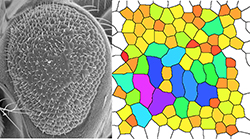
Figure 1.  Epithelial cells expressing ectopic Shroom3 (green) exhibit apical constriction.Figure 1. Epithelial cells expressing ectopic Shroom3 (green) exhibit apical constriction.How is it that cells manage to regulate their shape and organization during embryonic development in order to form the various tissues and diverse body plans seen in adult organisms? In most circumstances, cells utilize the coordinated efforts of signaling pathways, effector proteins, cytoskeletal networks, and contractile myosins to elicit the changes in cell morphology needed to form tissues and structures with beautiful and elaborate architecture.  Understanding the regulation and integration of these cellular components, pathways, and networks in these fascinating processes is the main objective of the work in the Hildebrand lab.  We use a variety of genetic, cellular, biochemical, and molecular approaches to understand how cell and tissue morphology is regulated.  We are currently studying the function and regulation of the Shroom family of proteins as a model to understand these processes. 
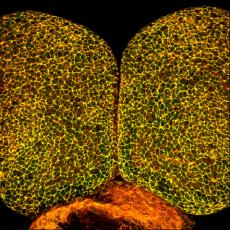
Figure 2.  Expression of endogenous Shroom (green) in the morphogenetic furrow of the Drosophila eye imaginal disc.Figure 2. Expression of endogenous Shroom (green) in the morphogenetic furrow of the Drosophila eye imaginal disc.Using numerous in vivo and in vitro model systems and approaches, we have shown that Shroom proteins are a family of actin-associated scaffolding molecules that control cellular architecture (Figure 1) and tissue morphology during processes such neural tube closure, vascular organization, and Drosophila embryogenesis (Figure 2). To date we have characterized the functions of vertebrate Shroom2, 3, and 4 and the ortholog of Shroom, from Drosophila melanogaster.  It appears that all Shroom proteins control cell and tissue architecture by regulating the distribution of contractile actomyosin networks.  This activity is dependent on the ability of Shroom proteins to bind and recruit Rho-kinase, an activator of non-muscle myosin II, to specific regions of the cell.  Once recruited, we hypothesize that Rock locally activates myosin II and subsequently changes or regulates cell contractility or shape. The current work in our lab endeavors to understand the molecular, biochemical, and cellular basis for how Shroom proteins control actomyosin networks.  In addition, we are trying to elucidate how different types of contractile networks are assembled in a cell and what outcomes these different types of networks may have on cell behavior and tissue morphology.  Finally, we are using cellular and genetic analysis to define other players in the Shroom network and identify other pathways that cooperate with Shroom to control cellular behaviors. 

Recent Publications
  • Mohan S, Rizaldy R, Das D, Bauer RJ, Heroux A, Trakselis MA, Hildebrand JD, VanDemark AP (2012) Structure of the Shroom Domain 2 reveals a three-segmented coiled-coil required for dimerization, Rock binding, and apical constriction. Mol Biol Cell [epub]

  • Plageman TF Jr, Chauhan BK, Yang C, Jaudon F, Shang X, Zheng Y, Lou M, Debant A, Hildebrand JD, Lang RA. (2011) A Trio-RhoA-Shroom3 pathway is required for apical constriction and epithelial invagination. Development. 138:5177-88

  • Grosse AS, Pressprich MF, Curley LB, Hamilton KL, Margolis B, Hildebrand JD, Gumucio DL. (2011) Cell dynamics in fetal intestinal epithelium: implications for intestinal growth and morphogenesis. Development.138 (20): 4423-32.

  • Farber, M.J., R. Rizaldy, and J.D. Hildebrand (2011) Shroom2 regulates contractility to control endothelial morphogenesis. Mol Biol Cell 22:795-805

  • Mo, D., B.A. Potter, C.A. Bertrand, J.D. Hildebrand, J.R. Bruns, and O.A. Weisz (2010) Nucleofection disrupts tight junction fence function to alter membrane polarity of renal epithelial cells. Am. J. Physiol. Renal Physiol. 299(5):F1178-84

  • Bolinger, C., L. Zasadil, R. Rizaldy, and J.D. Hildebrand (2010) Specific isoforms of Drosophila shroom define spatial requirements for the induction of apical constriction. Dev. Dynam. 239:2078-2093

  • Plageman TF, J.r, M.I. Chung, M. Lou, A.N. Smith, J.D. Hildebrand, J.B. Wallingford, and R.A. Lang (2010) Pax6-dependent Shroom3 expression regulates apical constriction during lens placode invagination. Development 137:405-415

  • Yoder, M., and J.D. Hildebrand (2007) Shroom4 (KIAA1202) is an actin-associated protein implicated in cytoskeletal organization. Cell Motil. Cytoskel. 64:49-63

  • Hagens, O., A. Ballabio, V. Kalscheuer, J.P. Kraehenbuhl, M.V. Schiaffino, P. Smith, O. Staub, J. Hildebrand, and J.B. Wallingford (2006) A new standard nomenclature for proteins related to Apx and Shroom. BMC Cell Biol 7:18

  • Fairbank, P.D., C. Lee, A. Ellis, J.D. Hildebrand, J.M. Gross, and J.B. Wallingford (2006) Shroom2 (APXL) regulates melanosome biogenesis and localization in the retinal pigment epithelium. Development 133:4109-4118

  • Dietz, M.L., T.M. Bernaciak, F. Vendetti, and J.D. Hildebrand (2006) Differential actin-dependent localization modultes the evolutionarily conserved activity of shroom-family proteins. J. Biol. Chem. 281:20542-20554

  • Hildebrand, J.D. (2005) CtBP proteins in vertebrate development. Pp in CtBP Family Proteins, Chinnadurai, G., Ed. Landes Bioscience

  • Hildebrand, J.D. (2005) Shroom regulates epithelial cell shape via the apical positioning of an actomyosin network. J. Cell Sci. 118:5191-5203

  • Haigo, S.L., J.D. Hildebrand, R.M. Harland, and J.B. Wallingford (2003) Shroom induces apical constriction and is required for hingepoint formation during neural tube closure. Curr. Biol. 13:2125-2137

  • Zhang, Q., Y. Yoshimatsu, J. Hildebrand, S.M. Frisch, and R.H. Goodman (2003) Homeodomain Interacting Protein Kinase 2 Promotes Apoptosis by Downregulating the Transcriptional Corepressor CtBP. Cell 115:177-186

  • Lin, X., B. Sun, M. Liang, Y.Y. Liang, A. Gast, J. Hildebrand, F.C. Brunicardi, F. Melchior, and X.H. Feng (2003) Opposed regulation of corepressor CtBP by SUMOylation and PDZ binding. Mol. Cell 11:1389-1396

  • Grooteclaes, M., Q. Deveraux, J. Hildebrand, Q. Zhang, R.H. Goodman, and S.M. Frisch (2003) C-terminal-binding protein corepresses epithelial and proapoptotic gene expression programs. Proc. Natl. Acad. Sci., USA 100:4568-4573

  • Hildebrand, J.D., and P. Soriano (2002) Overlapping and unique roles for C-terminal binding protein 1 (CtBP1) and CtBP2 during mouse development. Mol. Cell. Biol. 22:5296-5307

E-mail Lab