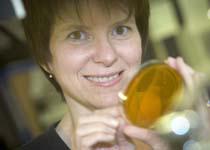
Professor
Transcriptional control
Education
Dr. Arndt received her Ph.D. in 1988 with Michael Chamberlin at the University of California at Berkeley, performed her postdoctoral studies with Fred Winston at Harvard Medical School, and joined the Department in 1994.
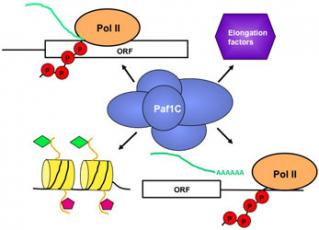
Figure 1. The multifunctional Paf1 complex associates with RNA pol II, promotes histone modifications coupled to active transcription, interacts with other transcription and chromatin factors, and regulates RNA 3’-end formation.A critical question to ask, particularly in this genomic era, is how organisms interpret the vast amounts of information encoded in their genomes. The Arndt lab studies the first step in gene expression, the synthesis of mRNA by RNA polymerase II, with a focus on the mechanisms that regulate transcription in the chromatin environment of a eukaryotic cell. The fundamental importance of understanding transcriptional regulation is evident from the large number of human developmental defects and diseases, including cancer and AIDS, that arise when cellular transcription factors are altered by mutation or commandeered by viral proteins.
The transcription cycle can be divided into three steps: (1) promoter recognition and initiation of RNA synthesis; (2) elongation of the growing RNA chain; and (3) termination. Our current studies focus on the elongation and termination steps in the cycle. In our research, we exploit a vast array of genetic, biochemical, and genomic tools uniquely available in the model eukaryote, Saccharomyces cerevisiae. This simple yeast is an excellent model system for our studies because the proteins and mechanisms that regulate transcription have been highly conserved from yeast to man.
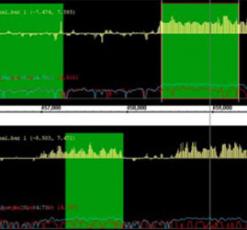
Figure 2. High resolution DNA microarray technology can be used to identify transcriptional patterns in different yeast strains.During transcription elongation, RNA polymerase II encounters obstacles, notably nucleosomes, which block its path. Eukaryotes express proteins that facilitate or impede polymerase movement by altering the chromatin template. One of these proteins is the conserved Paf1 complex. The Paf1 complex associates with RNA polymerase II on the coding regions of transcribed genes, interacts with other highly conserved elongation factors, couples histone modification to transcription elongation, and controls the efficiency of transcription termination. Thus, the Paf1 complex is a multifunctional regulator of gene expression that lies at the intersection between transcription elongation and chromatin modification. Current projects in the lab are focused on:
- The mechanisms by which the Paf1 complex regulates transcription elongation and events coupled to this process, especially RNA 3' end formation
- The genes that are regulated by the Paf1 complex and how the Paf1 complex is recruited to these genes
- The mechanisms by which the Rtf1 subunit of the complex controls histone modifications
- The functions of the Cdc73 subunit of the Paf1 complex, a protein with tumor suppression activity in human cells
- The cellular factors, including a novel ubiquitin protein-ligase, that protect the cell against the consequences of deregulated transcription

Recent Publications
Tomson, B.N., Crisucci, E.M., Heisler, L.E., Gebbia, M., Nislow, C. and Arndt, K.M. (2013) Effects of the Paf1 complex and histone modifications on snoRNA 3'-end formation reveal broad and locus-specific regulation. Mol. Cell. Biol., 33:170-182
Tomson, B.N. and Arndt, K.M. (2013) The many roles of the conserved eukaryotic Paf1 complex in regulating transcription, histone modifications, and disease states. Biochim. Biophys. Acta 1829:116-126
Piro, A. S., Mayekar, M. K., Warner, M. H., Davis, C. P., and K. M. Arndt (2012) Small region of Rtf1 protein can substitute for complete Paf1 complex in facilitating global histone H2B ubiquitylation in yeast. Proc. Natl. Acad. Sci. USA 109:10837-10842
Klucevsek, K.M., Braun, M.A., and K.M. Arndt (2012) The Paf1 complex subunit Rtf1 buffers cells against the toxic effects of [PSI+] and defects in Rkr1-dependent protein quality control in Saccharomyces cerevisiae. Genetics 191: 1107-1118
Amrich, C.G., Davis, C.P., Rogal, W.P., Shirra, M.K., Heroux, A., Gardner, R.G., Arndt, K.M. and VanDemark, A.P. (2012) The Cdc73 subunit of the Paf1 complex contains a C-terminal Ras-like domain that promotes association of the Paf1 complex with chromatin. J. Biol. Chem., 287:10863-10875.
Crisucci, E.M. and Arndt, K.M. (2012) Paf1 restricts Gcn4 occupancy and antisense transcription at the ARG1 promoter. Mol. Cell Biol. 32:1150-1163
Crisucci, E.M. and K.M. Arndt (2011) The roles of the Paf1 complex and associated histone modifications in regulating gene expression. Genetics Research International 2011:doi:10.4061/2011/707641
Crisucci, E.M. and K.M. Arndt (2011) The Paf1 complex represses ARG1 transcription in Saccharomyces cerevisiae by promoting histone modifications. Euk. Cell 10:712-723
Tomson, B.N., C.P. Davis, M.H. Warner, and K.M. Arndt (2011) Identification of a role for histone H2B ubiquitylation in non-coding RNA 3'-end formation through mutational analysis of Rtf1 in S. cerevisiae. Genetics 188: 273-289
Shirra, M.K., R.R. McCartney, C. Zhang, K.M. Shokat, M.C. Schmidt, and K.M. Arndt (2008) A chemical genomics study identifies Snf1 as a repressor of GCN4 translation. J. Biol. Chem. 283:35889-35898
Rubenstein, E.M., R.R. McCartney, C. Zhang, K.M. Shokat, M.K. Shirra, K.M. Arndt, and M.C. Schmidt (2008) Access denied: Snf1 activation loop phosphorylation is controlled by availability of the phosphorylated threonine 210 to the PP1 phosphatase. J. Biol. Chem. 283:222-230
Arndt, K.M. (2007) Molecular biology: genome under surveillance. Nature 450:959-960
Chu, Y., R. Simic, M.H. Warner, K.M. Arndt, and G. Prelich (2007) Regulation of histone modification and cryptic transcription by the Bur1 and Paf1 complexes. EMBO J. 26:4646-4656
Warner, M.H., K.L. Roinick, and K.M. Arndt (2007) Rtf1 is a multifunctional component of the Paf1 complex that regulates gene expression by directing cotranscriptional histone modification. Mol. Cell Biol. 27:6103-6115
Braun, M.A., P.J. Costa, E.M. Crisucci, and K.M. Arndt (2007) Identification of Rkr1, a nuclear RING domain protein with functional connections to chromatin modification in Saccharomyces cerevisiae. Mol. Cell. Biol. 27:2800-2811
Sheldon, K.E., D.M. Mauger, and K.M. Arndt (2005) A requirement for the Saccharomyces cerevisiae Paf1 Complex in snoRNA 3' end formation. Mol. Cell 20:225-236
Arndt, K., and F. Winston (2005) An unexpected role for ubiquitylation of a transcriptional activator. Cell 120:733-734
Shirra, M.K., S.E. Rogers, D.E. Alexander, and K.M. Arndt (2005) The Snf1 protein kinase and Sit4 protein phosphatase have opposing functions in regulating TBP association with the Saccharomyces cerevisiae INO1 promoter. Genetics 169:1957-1972
Arndt, K.M., and C.M. Kane (2003) Running with RNA polymerase: eukaryotic transcript elongation. Trends Genet. 19:543-550
Simic, R., D.L. Lindstron, H.G. Tran, K.L. Roinick, P.J. Costa, A.D. Johnson, G.A. Hartzog, and K.M. Arndt (2003) Chromatin remodeling protein Chd1 interacts with transcription elongation factors and localizes to transcribed genes. EMBO J. 22:1846-4856
Spencer, J.V., and K.M. Arndt (2002) A TATA binding protein mutant with increased affinity for DNA directs transcription from a reversed TATA sequence in vivo. Mol. Cell. Biol. 22:8744-8755
Squazzo, S.L., P.J. Costa, D. Lindstrom, K.E. Kumer, R. Simic, J.L. Jennings, A.K. Link, K.M. Arndt, and G. Hartzog (2002) The Paf1 complex physically and functionally associates with transcription elongation factors in vivo. EMBO J. 21:1764-1774
Shirra, M.K., J. Patton-Vogt, A. Ulrich, O. Liuta-Tehlivets, S.D. Kohlwein, S.A. Henry, and K.M. Arndt (2001) Inhibition of acetyl coenzyme A carboxylase activity restores expression of the Ino1 gene in a snf1 mutant strain of Saccharomyces cerevisiae. Mol Cell Biol 21:5710-5722
- Manasi Mayekar, Graduate Student
- Margaret Shirra, Post Doc
- Brett Tomson, Post Doc
- S. Branden Van Oss, Graduate Student
- Christine Cucinotta, Graduate Student